The Last Skeleton Key
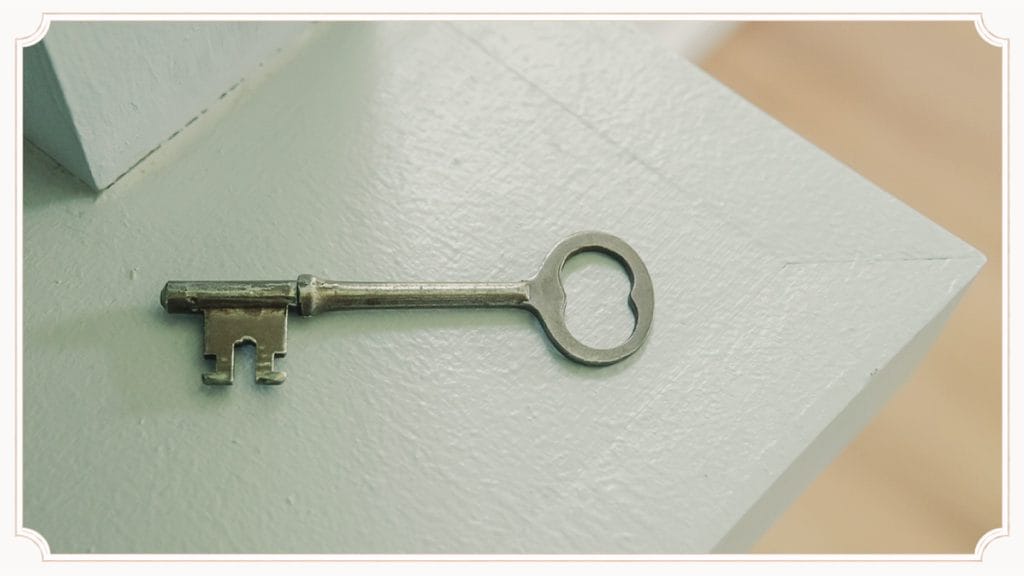
For over eighty years, one little key has quietly remained with the cottage, opening its doors to new families and new discoveries.
There is one key in our house that we try very hard not to lose. It isn’t attached to a modern key fob. There isn’t a spare tucked into a drawer somewhere, and replacing it wouldn’t be as simple as having another one cut at the hardware store.
It is an old skeleton key.
And as far as we know, it is the last one left.
The small brass key has been part of The Cottage for generations. Its surface has darkened with age, its edges have been worn smooth from years of being held, and yet more than eighty years after the cottage was built, it still does exactly what it was made to do.
It unlocks the doors.
Not just one of them.
The same little key works in the original locks throughout The Cottage, and we use it every day.
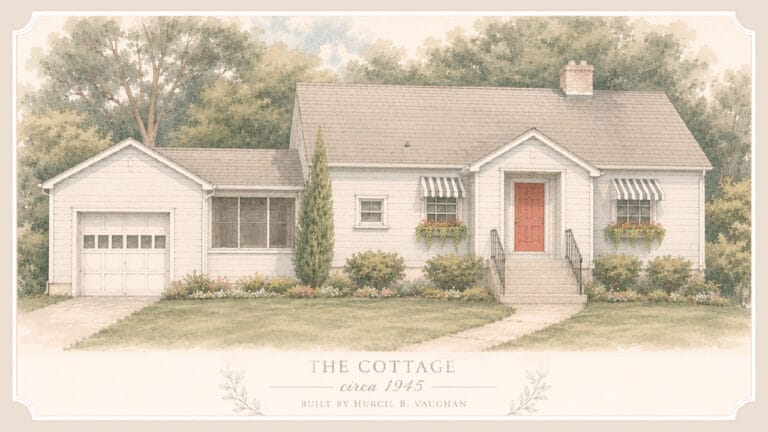
When Hurcil built the cottage in 1945, the interior doors were fitted with mortise locks, dainty escutcheons, and simple brass knobs. All the mechanisms still work today. Turn one of the old knobs, and you can hear the latch move inside. Look beneath it, and there is the familiar keyhole that belongs to another era of homebuilding.
When we stepped inside the cottage, the tiny brass doorknobs and keyholes were some of the first details we fell in love with. At the time, we didn’t think the mechanisms still worked, much less that there was a surviving key.
A Little Surprise Left Inside a Drawer
We don’t know how many skeleton keys there once were. There may have been several scattered throughout the house. Perhaps they were kept in their doors or gathered together somewhere convenient. Over eighty years, they could have been misplaced, carried away, or simply disappeared as families moved and rooms changed.
We only know that one remained.
Once we purchased the cottage, we began tidying up and cleaning every surface, cabinet, and drawer. Inside one small drawer in the kitchen was a shiny brass key.
Immediate elation hit us.
We rushed over to try it in the first door we could. Surprisingly, it worked the lock.
Then we tried the next door.
And the next.
Until we discovered that this one little key locked and unlocked every door in The Cottage.
Some were tight and some locks were stuck, but over time we restored all of them to perfect working condition.
This surviving piece of history isn’t kept behind glass or tucked safely away with the things we’ve found. The key stays nestled in the sitting room door, ready to work any lock we need at any given moment.
It is history we can hold in our hand, but it is also a household object with a job to do.
That combination makes it one of our favorite original details.
When the moment arises and we grasp the worn brass between our fingers and hear the quiet click of a lock that has been working since this little cottage was new, we’re reminded that an everyday task doesn’t feel quite so ordinary here.
Hurcil couldn’t have known when these doors were hung in 1945 that another family would be standing here more than eighty years later, still using a key made for his locks.
And yet, we do.
We turn the same little key.
We hear the same lock click.
And then we go about our day.
The last skeleton key isn’t simply something that survived from the cottage’s past. It continues to be part of its present.
And hopefully, its future.
Until next week,

Next Week
Some mysteries in an old cottage aren’t noticeable in plain sight. Sometimes, they’re hidden.
The Cottage Mystery Series Part Three — The Door to Nowhere