Hidden Beauty
Some of our favorite details at the cottage are the ones that were thoughtfully selected eighty years ago.
Each day as we came and went, we would pass by the railing along the breezeway steps. Our hands would reach out for support of the fixed iron structure as we carefully stepped along the slate floor. Over time, we noticed more railings placed along the front porch and again surrounding the attic landing.
For a while, they were for us simply part of the house that provided safety and support.
Then one day, we started looking at them a little more closely and realized none of them matched.
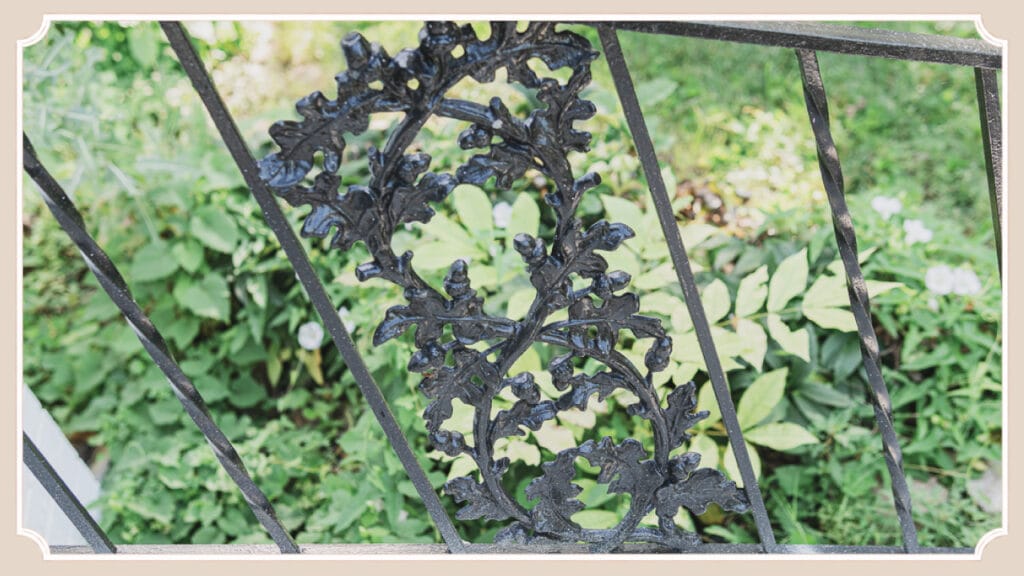
The railing at the front steps is the most elaborate. What looks like decorative scrollwork from a distance becomes something entirely different when you get close. The iron reveals branches. Leaves twist their way through the iron, with little acorns tucked among them. Some turn outward while others overlap, giving the whole design the slightly irregular appearance of something that might actually have grown there. Once we recognized the pattern, we couldn’t believe we’d walked past it so many times without really seeing it. But the front steps weren’t the only place the cottage had been given a little extra decoration.
At the top of the attic stairs, we found yet another design. The ironwork there is filled with roses and leaves winding around a central stem. It’s more formal than the oak branches outside.
In the breezeway, the ironwork is much simpler. There are no leaves or flowers here. Instead, pairs of traditional scrolls curve toward one another in a symmetrical pattern between the straight iron rails. Its beauty is quieter than both prior railings, yet still decorative but restrained.
Three railings.
Three different patterns.
All in one little cottage.
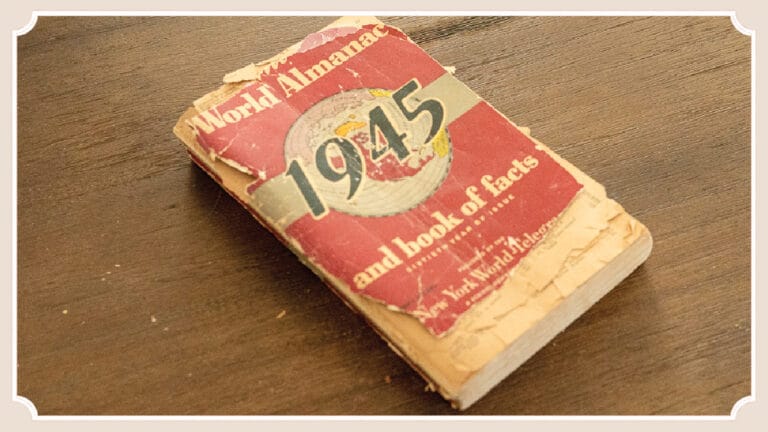
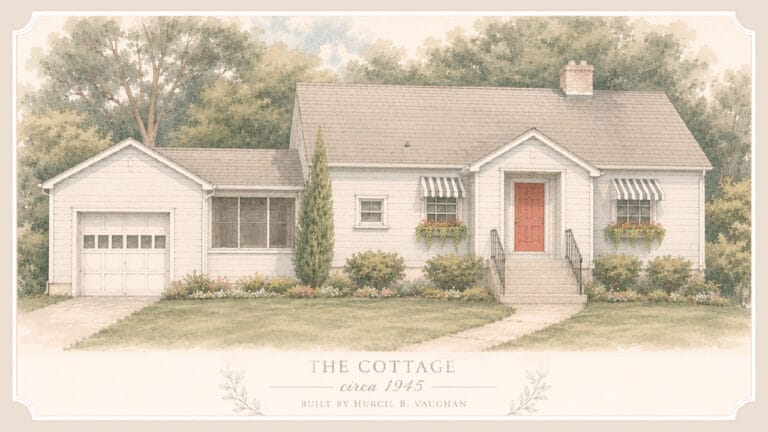
The cottage was built in 1945, during a period when the Cape Cod had once again become a popular American house style. Cape Cod homes have much older roots. Their story reaches back to early New England, where English building traditions were adapted into the simple houses that eventually became associated with the Cape. Centuries later, Americans returned to those older forms.
By the time our cottage was built, Cape Cod had become a familiar choice for a modest family home: simple, practical and rooted in architectural traditions much older than itself. That made the decorative ironwork particularly interesting to us. Leaves, flowers and curling scrolls had been appearing in European and British decorative arts for centuries. Oak leaves and acorns could be found in architectural ornaments. Roses and vines had long made their way from the garden into textiles, woodwork, metalwork and other parts of the home. And the familiar curves of traditional iron scrollwork reached back even further.
Those traditions didn’t disappear when houses became simpler. They were adapted and reinterpreted, and eventually found their way into American homes.
The little cottage isn’t grand, and it was never meant to be. Its rooms are modest. Its architecture is simple. Most of its original details are practical rather than showy. And yet, Hurcil still made room for beauty.
Just enough oak leaves beside the front steps, simple utilitarian curves along the breezeway stairs, and roses blooming in the attic. These details weren’t necessary for the railings to do their job, but eighty years later they are still making people who enter this little cottage smile when their hidden beauty is noticed.
Until next week,

Next Time
By the time we found the cottage, a new family had already left their mark on its story.
Next week, we begin looking at The First Renovation Series and the changes that helped shape the cottage we know today.